
A closer look at why daily routines shape how deeply you rest.
For many people, sleep feels like something that either happens or doesn’t.
Some nights it arrives easily.
Other nights it seems distant, even when you feel physically tired.
But sleep scientists have learned something important over the last several decades:
Sleep is not a single event.
It is the result of signals your body receives throughout the day.
The light you see in the morning.
The caffeine you drink in the afternoon.
The way your mind winds down in the evening.
All of these signals shape how easily your body transitions into sleep later at night.
Research from the National Institutes of Health shows that consistent lifestyle signals help stabilize circadian rhythms and improve sleep quality.
In other words, better sleep often begins with small habits repeated consistently.
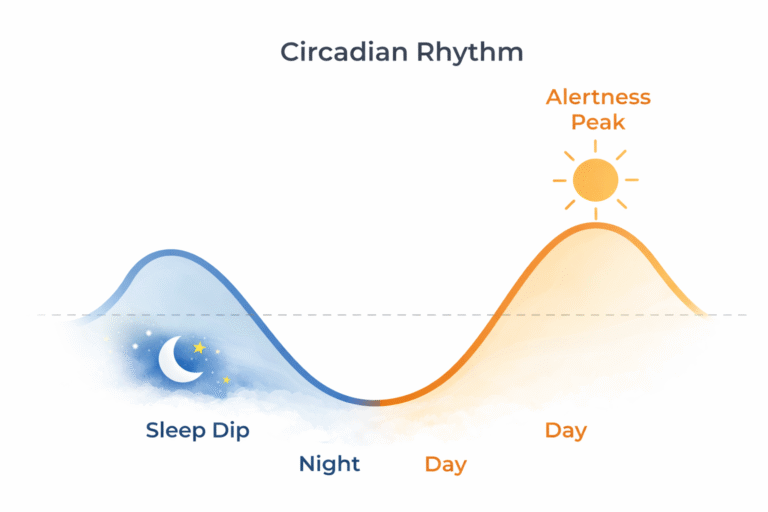
The human body runs on an internal clock called the circadian rhythm.
This biological rhythm operates on roughly a 24-hour cycle and regulates several processes including:
The suprachiasmatic nucleus (SCN) in the brain acts as the master clock that coordinates these rhythms.
Light exposure is the strongest signal influencing this clock.
According to research from Harvard Medical School’s Division of Sleep Medicine, exposure to natural light early in the day helps anchor the circadian rhythm, making it easier for the body to feel sleepy at night.
Without these signals, the sleep-wake cycle becomes less predictable.
That unpredictability often shows up as:
Many people assume that improving sleep requires dramatic lifestyle changes.
But sleep researchers often emphasize something much simpler: consistency.
Going to bed at roughly the same time each night helps the brain predict when sleep should occur.
Research published in Sleep Health: Journal of the National Sleep Foundation found that irregular sleep schedules are strongly associated with poorer sleep quality and increased daytime fatigue.
Even if someone sleeps eight hours per night, frequent shifts in bedtime can disrupt the body’s natural rhythm.
Small improvements in consistency can produce noticeable results over time.
This is why many sleep experts recommend maintaining similar sleep and wake times throughout the week whenever possible.
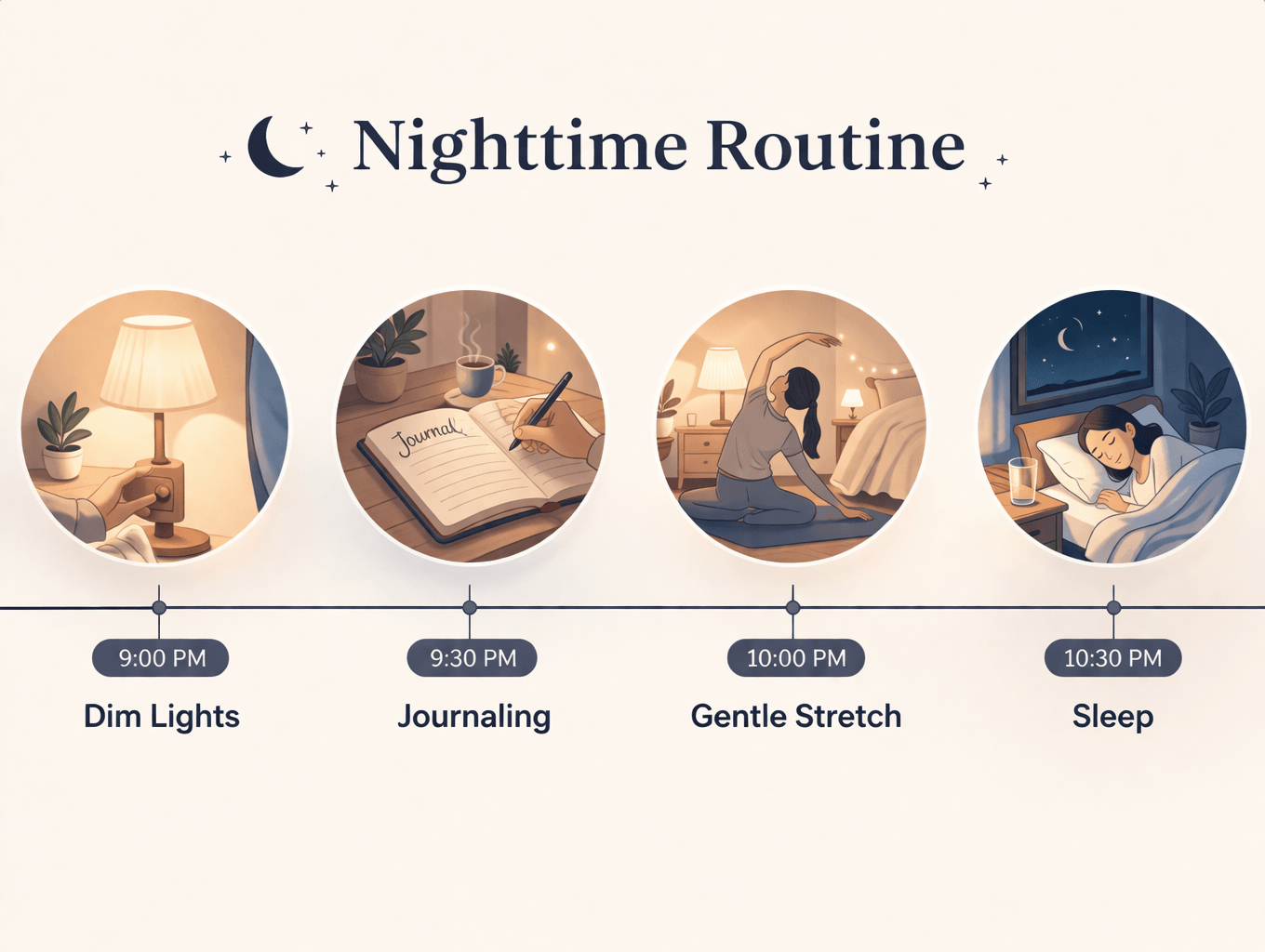
One of the most overlooked aspects of sleep is the transition period before bedtime.
During the day, the brain is constantly stimulated by information, decisions, and sensory input.
Without a gradual transition into rest, the mind may continue operating in an alert state long after the body is ready to sleep.
Sleep researchers refer to this as pre-sleep arousal.
A study published in the journal Sleep Medicine found that relaxation routines before bed can significantly improve sleep onset and reduce nighttime awakenings.
Common wind-down activities include:
These activities send signals to the nervous system that it is safe to shift into a resting state.
Sleep is extremely sensitive to environmental cues.
Research from the Journal of Clinical Sleep Medicine highlights three environmental factors that strongly influence sleep quality:
Light
Exposure to bright light suppresses melatonin, the hormone that signals the body to prepare for sleep.
Temperature
The body naturally cools during sleep. A cooler environment helps support this process.
Noise
Even low levels of sound can trigger brief awakenings that interrupt sleep cycles.
Optimizing the sleep environment often includes:
Small environmental changes can make a significant difference in how stable sleep becomes.
Sleep researchers often emphasize that sleep hygiene begins long before bedtime.
Daily habits play an important role in preparing the body for sleep.
For example, caffeine consumed later in the day can delay sleep onset.
Research published in the Journal of Clinical Sleep Medicine found that caffeine taken even six hours before bedtime can significantly reduce sleep duration.
Similarly, physical activity during the day supports better sleep at night.
Studies from the American Academy of Sleep Medicine show that regular exercise is associated with deeper slow-wave sleep.
Healthy daytime habits often include:
These factors create the biological conditions that allow sleep to happen naturally.
One reason sleep habits are powerful is that the brain responds strongly to predictable signals.
When the same signals occur regularly, the body learns to anticipate sleep.
For example:
If dim lighting, relaxation, and quiet activities occur every evening before bed, the brain begins associating these signals with sleep.
Over time, this association strengthens.
Psychologists often refer to this process as behavioral conditioning, and it forms the basis of many modern sleep improvement approaches, including elements of Cognitive Behavioral Therapy for Insomnia (CBT-I).
This is why simple routines practiced consistently can gradually transform sleep patterns.
Many people expect sleep improvements to happen immediately.
But sleep patterns usually develop over months or years, which means restoring balance may take time as well.
What matters most is not perfection, but steady progress.
Small adjustments in habits, environment, and routines can gradually help the body reestablish healthy sleep rhythms.
Once those rhythms stabilize, sleep often begins to feel more natural again.
Sleep is not controlled by a single factor.
It is shaped by a network of signals that influence the brain and body throughout the day.
Light exposure, daily activity, mental relaxation, environment, and consistent routines all contribute to how deeply you rest.
When these elements begin to align, sleep becomes less of a struggle and more of a natural process.
And often, it begins with something simple paying attention to the small habits that shape your nights.