
A science-backed explanation of what may actually be happening to your sleep.
So why do you still feel exhausted?
Perhaps this has happened to you before.
You go to bed at a reasonable time.
You wake up after what seems like a full night of sleep.
But instead of feeling refreshed, you feel heavy, groggy, or mentally foggy.
Sometimes it feels like your body slept but your mind didn’t.
If this sounds familiar, you’re not alone. Many people assume that sleep duration equals sleep quality, but sleep science tells a very different story.
According to research published by the National Sleep Foundation, adults generally need 7–9 hours of sleep per night, but sleep quality and sleep architecture matter just as much as total hours slept.
In other words:
You can sleep for eight hours and still wake up tired if the underlying structure of your sleep is disrupted.
Let’s look at why that happens.
When we sleep, our body cycles through multiple stages of sleep.
These stages repeat roughly every 90 minutes and include:
Each stage plays a different role in restoring the body and mind.
Deep sleep is responsible for physical restoration, immune function, and cellular repair.
REM sleep supports memory consolidation, emotional processing, and brain recovery.
If these cycles are interrupted, shortened, or poorly distributed across the night, you may wake up feeling tired even if you technically slept long enough.
Research from the American Academy of Sleep Medicine shows that fragmented sleep or reduced deep sleep is strongly associated with next-day fatigue and reduced cognitive performance.
So the real question becomes:
What is disrupting your sleep cycles?
One of the most common causes of unrefreshing sleep is mental overstimulation before bed.
If you’ve ever noticed that your thoughts become louder the moment you lie down, you’re experiencing something sleep researchers often call cognitive hyperarousal.
A study published in the journal Sleep Medicine Reviews found that individuals with insomnia symptoms frequently show elevated brain activity during the pre-sleep period, particularly in regions associated with worry and planning.
Your body may be lying still, but your brain is still working.
This can reduce the depth of sleep and delay entry into the deeper restorative stages of the sleep cycle.
Common triggers include:
When the mind doesn’t transition properly into sleep mode, the body never fully recovers overnight.
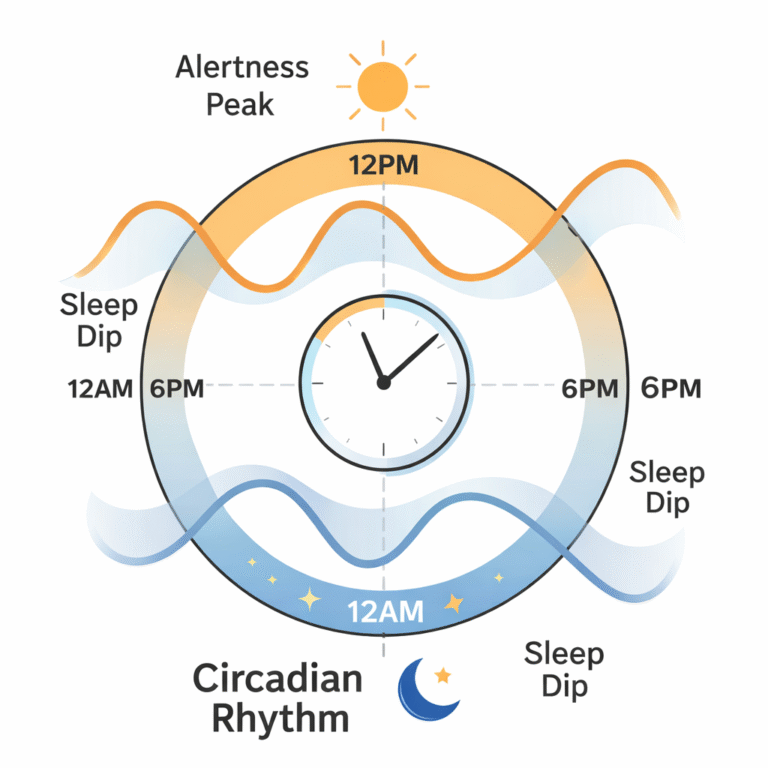
Another major reason people wake up tired is circadian rhythm disruption.
Your circadian rhythm is your body’s internal clock. It regulates when you feel awake and when you feel sleepy.
This rhythm is influenced by several factors, including:
Research from Harvard Medical School’s Division of Sleep Medicine explains that even small irregularities in sleep timing can shift the circadian rhythm and reduce sleep efficiency.
For example:
If you go to bed at 11 PM one night and 2 AM the next night, your body struggles to maintain a stable rhythm.
Even if you sleep eight hours both nights, the biological timing of sleep may not align with your natural sleep cycle.
The result?
You wake up feeling out of sync.
Sleep is highly sensitive to environmental signals.
Even subtle disturbances can reduce sleep depth and continuity.
Research from the Journal of Clinical Sleep Medicine shows that environmental factors such as temperature, noise, and light exposure can significantly affect sleep quality.
Some common environmental triggers include:
The body needs a cool, dark, and quiet environment to maintain stable sleep cycles.
If these conditions aren’t met, your brain may repeatedly shift toward lighter sleep stages throughout the night.
That means your sleep is technically long enough but never deep enough.
Sleep doesn’t begin when you go to bed.
It begins many hours earlier.
Lifestyle habits throughout the day can dramatically affect sleep quality later at night.
For example:
Caffeine consumed in the afternoon can remain in your bloodstream for six hours or longer, according to research published in the Journal of Clinical Sleep Medicine.
Similarly, limited exposure to natural light during the day can weaken circadian signals that help regulate sleep timing.
Other lifestyle influences include:
Sleep is essentially the result of a sequence of signals your body receives throughout the day.
If those signals are inconsistent, your sleep becomes inconsistent too.
One overlooked factor is that people do not sleep the same way.
Some people naturally think more at night.
Some are sensitive to heat.
Some move frequently during sleep.
Some wake up easily from small disturbances.
Sleep researchers increasingly recognize that sleep patterns tend to fall into distinct behavioral profiles.
Understanding your personal sleep tendencies can make it much easier to improve sleep effectively.
Because when you know how your sleep works, you can adjust your environment and habits accordingly.
If you consistently wake up feeling tired despite sleeping long enough, it’s often a signal that something in your sleep system needs adjustment.
That adjustment might involve:
The most important step is understanding what is influencing your sleep in the first place.
That’s why many modern sleep approaches begin with analyzing sleep patterns and identifying personal sleep profiles before recommending changes.
When you understand your sleep, improving it becomes much simpler.
Sleep is not just a number on a clock.
It’s a biological process influenced by the mind, the body, the environment, and daily habits.
If you’re sleeping eight hours but still waking up tired, it doesn’t mean sleep isn’t working.
It usually means your sleep system needs alignment.
And the good news is that once you understand what’s affecting your nights, better sleep often becomes much more achievable.